Skip to content
Public Record

Reader guide

How to Use Public Record

A plain-language walkthrough of the request tracker, evidence graph, records library, status colors, and the terms used throughout the site.

Start with a question. Check the evidence status. Follow the source record. Note what is still missing.

Status labels describe the available record. They are not findings of wrongdoing. This guide is educational, not legal advice.

Quick path

Five steps to follow the record

  1. 1

    Start with a place, concern, or open question.

    Explore places →

  2. 2

    Check the Open Records Tracker for what has been requested and what remains incomplete.

    Open the tracker →

  3. 3

    Open the Records page to distinguish evidence status from publication/access status.

    View records and methodology →

  4. 4

    Use Connect the Dots to see only relationships supported by evidence and to identify missing links.

    Explore the graph →

  5. 5

    Check the last-verified date, official source links, and unresolved items before drawing a conclusion.

    Review site updates →

Read the Open Records Tracker

Open Records Tracker

Actual tracker snapshot

As of October 29, 2026

Filed or sent requests
5
Closed complete
0 of 5

Two tracker lists

Filed or sent requests are kept separate from records only identified as needed.

Two different statuses

Lifecycle status tracks administrative handling. Evidence status describes the available record.
  • The tracker separates formally filed or sent requests from records merely identified as needed.
  • None of the listed requests is closed as complete. ORR-2026-155 has no verified filing date, so its timing status is not evaluated yet.
  • The last-updated date tells readers when the tracker was last verified.
  • Request lifecycle is administrative handling; evidence status is the strength and completeness of documentation. They are different.
Open the live tracker →

Understand the timing colors

Actual examples from the tracker

As of October 29, 2026

Red · Timing

DAY 127 OPEN · NOT COMPLETE

WRITTEN COMPLIANCE GAP

The Town's stated July 15 production target passed. The production remains incomplete, and no later specific date and hour for the remaining records is documented.

Statutory checkpoint: 10 business days. Calendar age does not establish a universal production deadline.

Amber · Timing

DAY 44 SINCE SENT · DELIVERY PENDING

DELIVERY PENDING

Sent by certified mail September 15, 2026. Delivery has not yet been documented, so no legal-response clock or deadline is shown.

Statutory checkpoint: Not applied. It is not applied until delivery is documented.

Evidence colors · Record support

Evidence status is not request completion

DOCUMENTEDPARTIALLY DOCUMENTEDAWAITING RECORDSVERIFY

These chips describe how strongly the available evidence supports a point. They do not show whether a public-information request is complete.

“DAY 88 OPEN” is calendar age as of October 29, 2026, not a live count or a universal deadline. Section 552.221(a) requires prompt production—within a reasonable time, without delay. The 10-business-day point under § 552.221(d) is a written-notice checkpoint, not a universal production deadline.

Read one request card

Actual example · ORR-2026-101

Financial records and supporting documentation

PARTIAL

Actual tracker information as of October 29, 2026. File counts are not completion percentages.

Request reference
ORR-2026-101
Filed date
Filed June 24, 2026
Requester
Julie Clancy
Agency
Town of Laguna Vista
Accountable officer
Victor Treviño, City Manager
Processing contact
Julia Barrera, City Secretary
Production measure
16 files received
Known gap
6 requested record categories remain unresolved
Documented complete-availability date
None documented
Unresolved items
  • April 30 reporting, trial balance, and supporting schedules
  • Bank and cash-to-ledger reconciliations
  • Fund-balance classifications and rollforward
  • Reserve calculation, funding source, transfers, and authorization
  • Fund-balance, reserve, financial-management, and minimum-reserve policies
  • Journal entries and interfund-transfer schedules
Request reference
The agency number or public identifier, when documented.
Filed or sent date
When the request was filed or sent; the wording identifies which one is known.
Requester
The person who submitted or sent the request.
Agency
The governmental body from which records are sought.
Accountable officer
The official assigned responsibility for public information and its release.
Processing contact
The office handling intake, processing, or delivery.
Production measure
A count or description of what has been received and verified.
Known gap
The documented scope that remains unresolved.
Unresolved items
Specific records or tracking facts still needed.
Documented complete-availability date
The complete-availability date found in the public source set, if one is documented.

Use Connect the Dots

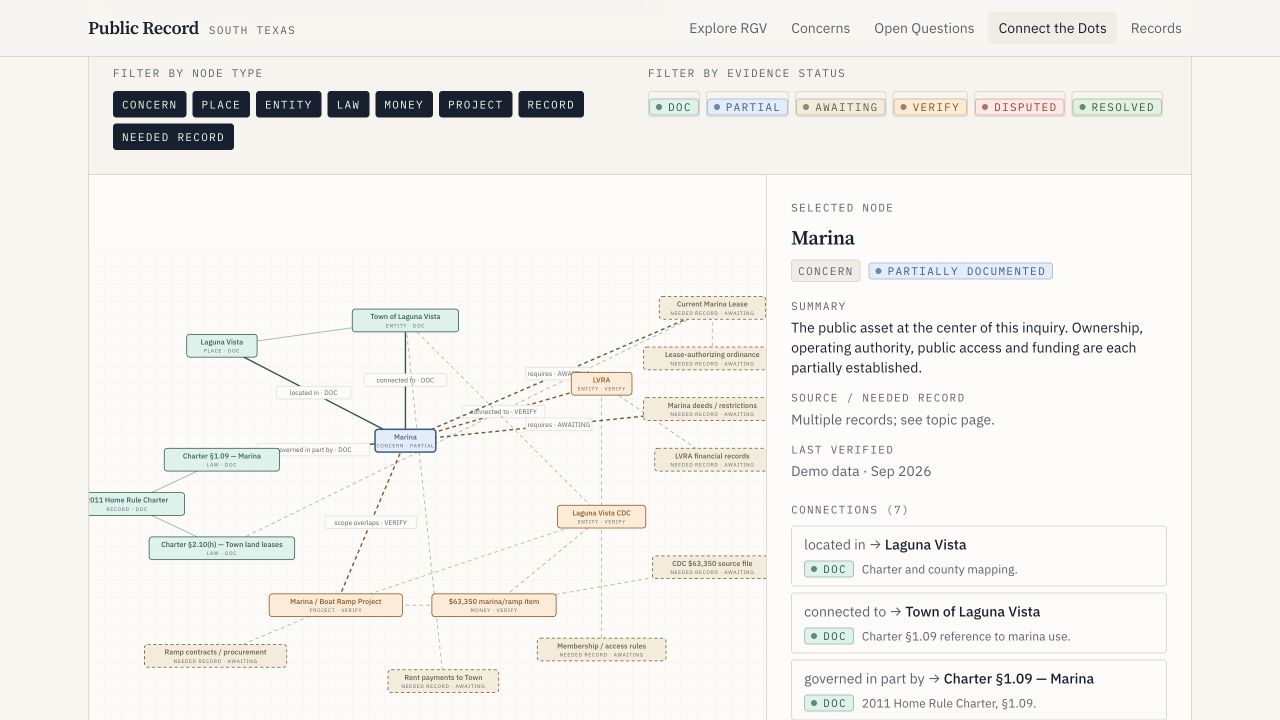
Desktop view of the Connect the Dots evidence graph with node and evidence-status filters, a network centered on Marina, and a selected-node detail panel.
The graph makes supported connections visible and marks relationships that still need records or verification.
  • Nodes represent places, entities, laws, money, projects, records, concerns, or needed records.
  • Solid arrows represent relationships supported by a primary record.
  • Dashed arrows identify relationships still awaiting evidence or requiring verification.
  • Selecting a node opens its summary, sources or needed records, last-verified date, and connections.
  • Node-type and evidence-status filters help readers narrow the graph.

No arrow without evidence.

Open Connect the Dots →

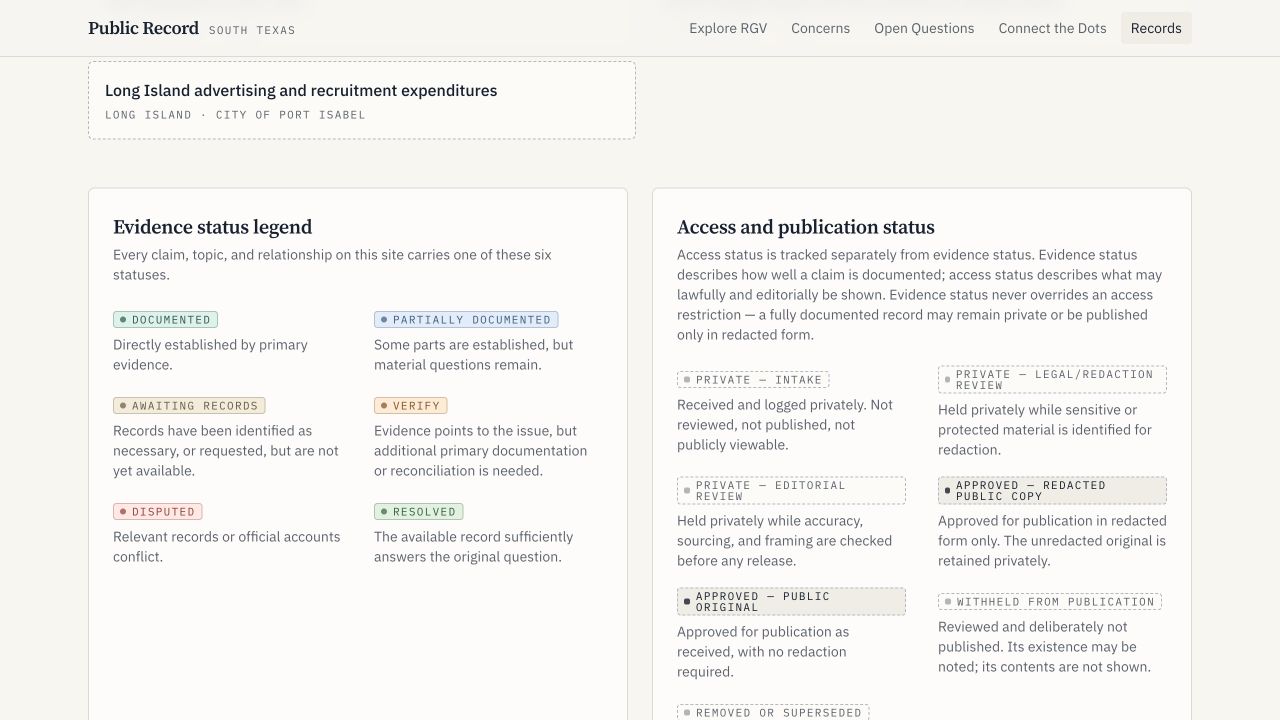
Evidence status is not access status

Desktop view of the Evidence status legend beside the separate Access and publication status legend.
The two status systems answer different questions and must be read separately.

Evidence status

DOCUMENTED
Directly established by primary evidence.
PARTIALLY DOCUMENTED
Some parts are established, but material questions remain.
AWAITING RECORDS
Records have been identified as necessary, or requested, but are not yet available.
VERIFY
Evidence points to the issue, but additional primary documentation or reconciliation is needed.
DISPUTED
Relevant records or official accounts conflict.
RESOLVED
The available record sufficiently answers the original question.

Access and publication status

  • PRIVATE — INTAKE
  • PRIVATE — LEGAL/REDACTION REVIEW
  • PRIVATE — EDITORIAL REVIEW
  • APPROVED — REDACTED PUBLIC COPY
  • APPROVED — PUBLIC ORIGINAL
  • WITHHELD FROM PUBLICATION
  • REMOVED OR SUPERSEDED

Evidence status describes how well a point is documented. Access status describes what may lawfully and editorially be shown. A fully documented record may still remain private or be published only in redacted form.

Reference

Glossary

ORR / public-information request
A request sent or filed for public information held by a governmental body.
Requester
The person who submitted or sent the request.
Responsive record
A record that falls within the request's stated scope.
Production
Records or information delivered in response to a request.
Production manifest
A list identifying what was produced and how it relates to the request.
Accountable officer
The official assigned legal responsibility for public information and its release.
Processing contact
The office or person handling request intake, processing, and delivery.
Evidence status
How strongly the available primary record establishes a point.
Access status
Whether and in what form material may be shown publicly.
Primary source
An original government record or other direct source used to support a statement.
Needed record
A record identified as necessary to answer a question but not yet available here.
Unresolved item
A specific part of a request or question that remains unanswered or unverified.
Statutory checkpoint
A legal process point that may require written action; it is not automatically a production deadline.
Documented availability date
A date and hour stated in writing for when information is expected to be available.
Redacted public copy
An approved public version with protected or sensitive material removed.
Last verified
The date the displayed public information was most recently checked against the available record.

Keep checking the record

How to stay informed

  • Recheck the Open Records Tracker’s last-updated date.
  • Read the public summary and unresolved items, not just the color chip.
  • Follow official source links.
  • Compare evidence status with access status.
  • Use Connect the Dots to find the source or needed record behind an arrow.
  • Review Site & Publication Updates for changes.
  • Legal Notice & Corrections explains how corrections are handled.